Evidence that Sex Attractant Pheromone Effects Strengthen with Continued Use
OCTOBER 2005
Poster presentation by Dr. Winnifred Cutler at ASRM Annual Meeting

Authors:
Millicent Zacher, DO , Thomas Jefferson University, Philadelphia, PA,
Elizabeth Genovese, M.D., University of Pennsylvania School of Medicine, Philadelphia, PA
OCTOBER 2005. The American Society for Reproductive Medicine held a conjoint annual meeting with the Canadian Fertility and Andrology Society called "Reproductive Medicine 2005: Expanding the Borders and Meeting New Challenges"
October 16 - 19, 2005, Palais de Congres, Montreal, Quebec, Canada
ASRM is a national and international medical society and the recognized leader for multidisciplinary information in the field of reproductive medicine. ASRM members reside in all 50 of the United States and in over 100 other countries. Members include obstetrician/gynecologists, urologists, reproductive endocrinologists, embryologists, mental health professionals, internists, nurses, practice administrators, laboratory technicians, pediatricians, research scientists, and veterinarians
Introduction:
In nature, pheromones are powerful agents driving reproduction and perpetuation of the species.
In 1986, the first human double blind, placebo controlled experiments located pheromones in underarm sweat extracts of sexually active fertile-aged men and women1.
Subsequently, the Athena Institute synthesized separate male and female sex attractant formulas as fragrance additives worn daily on the face.
Three double blind, placebo controlled trials have been completed:
* The Philadelphia trial tested the male formula on 38 men 26 to 42 years old.2
* The female formula was independently tested at San Francisco study on 36 women 19 to 48 years old.3
*The female formula was independently tested in 44 postmenopausal women 47 to 75 in Boston.4
A similar protocol was followed for each trial to provide prospectively recorded sociosexual behavioral monitoring of daily fragrance use during 2 baseline weeks and 6 experimental weeks.
To avoid the potential for menses abstinence to obscure effects, the San Francisco researchers expanded the experimental period to 9 weeks; testing 3 postmenses weeks from the last 2 cycles.3
Each study found that a greater proportion of pheromone than placebo users increased over their own individual baseline weekly frequency in sociosexual behaviors.
The biggest effects were:
* Sexual intercourse in the Philadelphia study of fertile-aged men (p < .01)
* Sexual intercourse in the San Francisco study of fertile-aged women (p < .01)
* Petting/kissing/affection in the Boston study of postmenopausal women (p < .02)
In the San Francisco study, pheromonal effects strengthened with continued use: “Significant effects appeared to occur within the first cycle and the proportion of women recording effects increased by the second cycle.”3
Objective:
Here we examine post hoc whether the same strengthening phenomenon occurred in the Philadelphia and Boston studies.
We hypothesize that pheromonal effects do strengthen with continued daily use.
Materials and Methods:
Subjects had recorded behavior daily and faxed their calendars weekly2.4 . After a 2-week baseline period they returned with their chosen fragrance and 5 ml of either placebo or test pheromone was added to 55 ml of their preferred fragrance. The chosen fragrance was worn daily throughout the entire 8 weeks; this provided both baseline and experimental phase exposure to the same preferred fragrance.
Design: Using tabulated records of the daily calendars, data were transposed to the number of days per week a behavior had been prospectively recorded. We used Chi Square, one-tailed.
* For men we tested sexual intercourse.
* For postmenopausal women we tested petting, kissing and affection
Results
Table 1: The Effect Of Daily Application Of Pheromone-Spiked Aftershave Strengthens Over 6 Weeks In Men
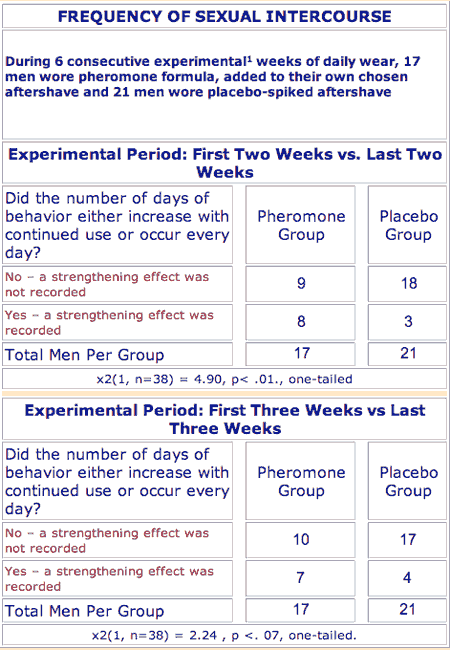
For male sexual intercourse,
A greater proportion of pheromone than placebo users recorded an increase in their weekly frequency when the first 2 weeks were compared to the last 2 experimental weeks.
A similar trend occurred when the first 3 vs. last 3 experimental weeks were compared .
1The 6 experimental weeks analyzed here followed a 2 week baseline period in which all 38 participants wore their chosen fragrance every day recording their behaviors.
Table 2: The Effect Of Daily Application Of Pheromone-Spiked Fragrance Strengthens Over 6 Weeks In Postmenopausal Women
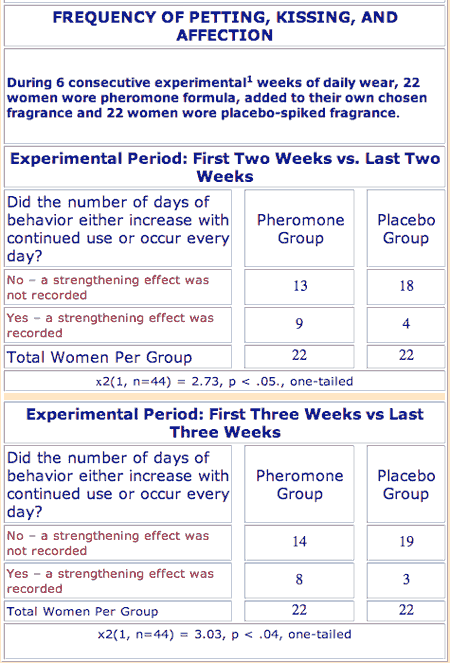
For postmenopausal petting, kissing, and affection,
A greater proportion of pheromone than placebo users recorded either an increase in their weekly frequency or maintained daily behavior , [7 d/week], when the first 2 vs. the last 2 experimental weeks were compared.
Comparing the first 3 weeks to the last 3 weeks showed similar results of pheromone (but not placebo) users increasing their behavior in the second half of the experimental period.
1The 6 experimental weeks analyzed here followed a 2 week baseline period in which all 44 participants wore their chosen fragrance every day recording their behaviors.
Conclusion and References
Conclusion
Behavioral effects that sex attractant pheromones promote seem to strengthen with regular daily use.
As usage continued, those who engaged in daily behavior maintained it; those with lower levels tended to increase.
References
1. Cutler WB, Preti G, Krieger A, Huggins GR, Garcia CR, Lawley RJ. Human axillary secretions influence women's menstrual cycles: the role of donor extract from men. Horm Behav 1986;20:463-473;
Preti G, Cutler WB, Garcia CR, Huggins GR, Lawley HJ. Human axillary secretions influence women's menstrual cycles: the role of donor extract of females . Horm Behav 1986;20:474-482.
2. Cutler WB, Friedmann E, McCoy NL. Pheromonal Influences on sociosexual behavior of men. Arch Sex Behav 1998;27(1):1-13
3. McCoy NL, Pitino L. Pheromonal influences on sociosexual behavior in women. Physio Behav 2002;75: 67-375
4. Rako S, Friebely J. Pheromonal influences on sociosexual behavior in postmenopausal women. JSexRes, 2004; 41:372-380
" My research has consistently focused on what behavior a woman can engage in to increase her power, well-being, and vitality."
---Winnifred B. Cutler, Ph.D.
A portion of the profits from our book and pheromone sales helps to fund Athena's on-going research.